
Research & Insights

As we highlight in our recent working paper, ESG 2.0: Managing & Measuring Investor Risks Beyond the Enterprise Level, there is strong evidence to show that both investors and companies engage in a range of activities that create negative impacts for the economy, which boomerang back to investors’ portfolios in the form of higher risk and lower return... Investors and their activities are the foundations of markets – comprising the “plumbing” upon which businesses and communities operate. Requiring corporate disclosure on ESG issues without also addressing structural issues relating to investor-level activity will leave markets with a “swiss cheese” style and incomplete understanding of risks.
Read More

ESG funds’ bias against workers is unintentional, but it is a feature rather than a bug […] A new paper by The Predistribution Initiative, ESG 2.0: Measuring & Managing Investor Risks Beyond the Enterprise-level, foregrounds potential negative impacts from capital structures themselves, not just portfolio companies.
Read More
A new report translates the difficult questions we have on sustainability into suggested investment changes […] “Predistribution Initiative’s ESG 2.0: Measuring & Managing Investor Risks Beyond the Enterprise-level tackles these systemic issues head on, providing a detailed analysis of problematic investment trends in recent years. The paper highlights the inherent contradictions of more ‘traditional’ ESG approaches to sustainable investing, applied commonly at the underlying enterprise or asset level, and the structural impact of asset allocation decisions at the level of the financial institution itself, particularly in relation to global economic inequality, increasingly recognised as posing systematic risk.”
Read More
Do environmental, social, and governance (ESG) and impact investing practices in their current forms provide investors with sufficient tools to play a meaningful role in “Building Back Better” following the COVID-19 crisis? Many investors, including those who identify as “Universal Owners,” often seek to manage ESG risk and opportunity through corporate governance interventions. However, certain investment structures can also have negative impacts relating to ESG goals and management of systematic risk. Furthermore, they can undermine the positive impacts sought by investors at the portfolio company-level.
Read More
PDI advisor, Kim Leslie Shafer, has spent significant time and effort engaging with various investor, legal, academic, and civil society networks to aggregate and synthesize perspectives. As a true leader, she is generously sharing the knowledge she has developed to encourage widespread responses to the SEC.
Read More
While data suggests that the ESG and impact investing markets are growing rapidly, concerns abound about how financial services firms are measuring and managing their ESG and impact investing performance writes Delilah Rothenberg.
Read More
According to a new report about the private equity (PE) industry, the majority of PE firms are not doing enough to take systematic risks seriously in both their business operations and investment portfolios.
Read More
The private equity industry is growing in importance. In recent years, companies have remained private longer. Furthermore, limited partner (LP) allocations to private markets continue to increase as underfunded pensions and endowments search for yield in a low interest rate environment, and in pursuit of diversification as the universe of public companies shrinks.
Read More
“The COVID-19 recession has prompted states to offer vast amounts of financial support to firms and households. When combined with steps that central banks have taken in response to the financial crisis of 2008, the bailout is so large that it has ushered in what Sebastian Mallaby, writing in the July/August 2020 issue of Foreign Affairs, calls “the age of magic money.” The combination of negative interest rates and low inflation, Mallaby writes, has created a world in which “don’t tax, just spend” makes for a surprisingly sustainable fiscal policy. The thrust of that description is accurate.”
Read More
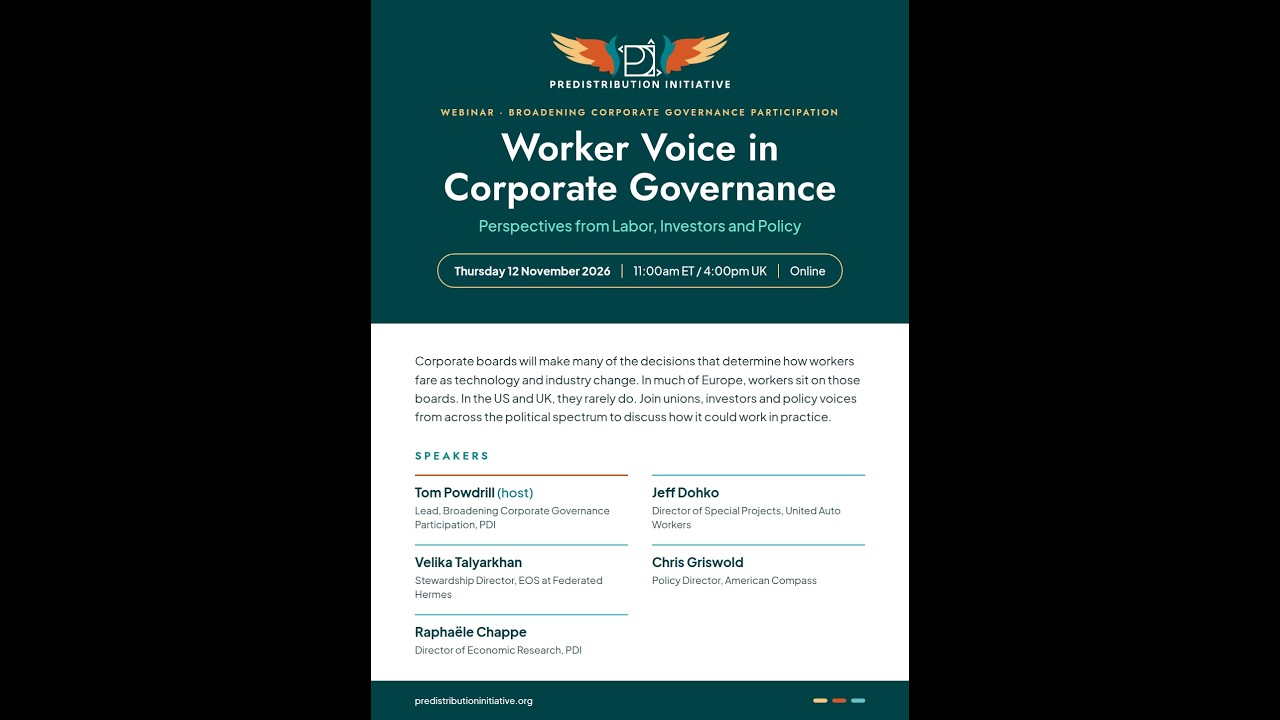
Worker Voice in Corporate Governance webinar replay

Webinar Replay: Worker Voice in Corporate Governance: Perspectives from Labor, Investors and Policy

Delilah Rothenberg, The Predistribution Initiative, on the ALAQA podcast

ALAQA Podcast: Delilah Rothenberg on Why Investors Should Treat Inequality as a Financial Risk

Delilah Rothenberg Speaks with Jahed Momand of the Ownership Economy

How workers sit at the heart of long-term value creation, and the case for multistakeholder governance and ownership 

Sustainable Finance Geneva - Interview of the Month

Women Changing Finance podcast - How investment structures can reduce inequality and build long-term resilience

New Private Markets podcast - How can investors better understand and address inequality as a systemic risk?

The Geneva Connection - Society in Finance: Bridging Gaps, Shaping Futures

Value Creation Through Responsible Investing: NYU Stern Center for Sustainable Business Private Equity Sustainability Practicum: Value Creation Through Responsible Investing

Virtual Launch of the Taskforce on Inequality and Social-Related Financial Disclosures (TISFD)

Perspectives on Workforce Directors: Opportunities & Challenges

Accelerator for Systemic Risk Assessment (ASRA)- From Multidimensional Challenges to Multidimensional Possibilities: Facing Global Risks Together